
When it comes to software testing, there’s a real split happening in Indian IT testing roles right now. Some testers’ pay has stalled, while others’ pay has jumped sharply. Strangely, the difference almost never comes down to years of experience. It comes down to specific skills, the tools a tester actually uses, and whether they can show real proof of what they’ve built.
India’s IT sector is on track to reach a $350 billion valuation by 2030, and testing, once seen as a small step at the end of development, has become one of the most important parts of how software gets built and shipped. Understanding the kind of skills a structured training programme you need, what software tester salary in India really looks like today, at every level, is one of the most useful things you can do for your career right now.
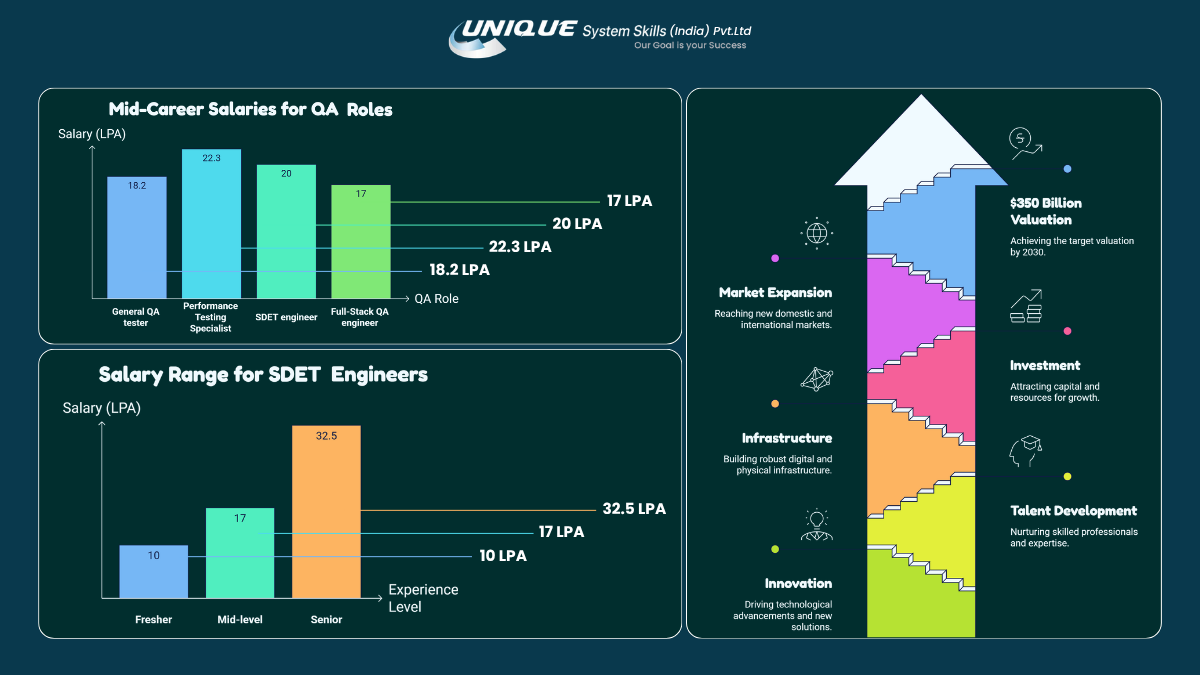
Comparison of QA role salaries and SDET engineer salary ranges across fresher, mid-level, and senior experience levels.
What Software Tester Pay Looks Like Across the Field
The first thing to understand is that Software testing covers a huge range of roles, and the pay gap between them is bigger than most people realize.
A general QA tester earns around ₹18.2 LPA on average at the mid-career level, while a performance testing specialist earns closer to ₹22.3 LPA, based on industry data. The SDET (Software Development Engineer in Test) path leads to the highest pay in the field. Freshers in SDET roles typically start at ₹4–10 LPA. Mid-level SDET engineers earn ₹12–22 LPA. Senior engineers reach ₹25–40 LPA.
At the very top, Principal Engineers and Engineering Managers at large GCCs and product companies can earn ₹60 LPA and above. Though these figures vary a great deal by company and should be treated as a rough guide, since very few roles exist at this tier and public data on them is limited.
City also matters a lot for software tester salary in India per month and overall pay. Bengaluru pays the most where mid-level SDET roles at GCCs there typically range from ₹18–38 LPA, while Hyderabad follows closely at ₹16–32 LPA. Pune, the Delhi NCR region, Mumbai, and Chennai are still competitive, but usually pay 10–20% less than Bengaluru for the same role and experience. The type of company matters just as much as the city. IT services firms like TCS and Infosys usually offer structured starting packages around ₹2.4–3.95 LPA for freshers, while product startups and GCCs often start 40–60% higher for candidates who can already show real automation skills.
Software Tester Salary for Freshers
If you’re just starting out, it helps to understand why 2 freshers with similar degrees can start at ₹3 LPA and ₹8 LPA.
Services Companies
At IT services companies like TCS, Infosys, Wipro, and Cognizant, software tester salary for freshers usually falls between ₹2.4–4 LPA, with structured training programmes built in. These roles are steady and accessible, and they teach real fundamentals including:
- understanding the software testing lifecycle
- writing test cases from requirements
- reporting bugs clearly, and following a bug through to resolution.
This groundwork isn’t exciting, but it matters. A tester who skips it will struggle later when they try to automate tests, because they haven’t yet built the habit of thinking carefully and systematically about what could go wrong.
Product Companies
At product companies, GCCs, and fast-growing startups, software tester salary for freshers can start at ₹6–10 LPA for candidates who already show automation skills through real project work. The median pay for fresh testers nationally sits around ₹4.25 LPA but that average hides a wide spread. The freshers earning above that average are almost always the ones who show up with a GitHub page full of real automation work including scripts they wrote, test frameworks they set up and results they documented. This is what we call ‘Proof of Work,’ and building it before your first interview is the single most useful thing a new tester can do.
CTC vs. Take-Home Pay
One of the most confusing things for testers at every level is the gap between the CTC number on an offer letter and the software tester salary in India per month that actually shows up in their bank account. But this gap isn’t a trick.
For a tester on a ₹6 LPA CTC, monthly take-home after PF deductions, professional tax, and income tax usually lands between ₹42,000 and ₹46,000, depending on the city and how the package is structured. At ₹12 LPA CTC, monthly take-home is typically ₹80,000–₹90,000. At ₹25 LPA, once the higher tax slab applies, take-home is usually around ₹1.4–1.6 lakh a month.
It helps to know what actually makes up a CTC.
Fixed base pay: 40–60% of the total
Variable performance bonuses: 15–25%
Employer PF contributions, gratuity, and medical insurance: 8–12% (aren’t paid to you directly).
ESOPs (Employee Stock Ownership Plans) at GCCs and funded startups can make up 20–40% of total pay at senior levels, and can meaningfully grow your real earnings over time if the company does well.
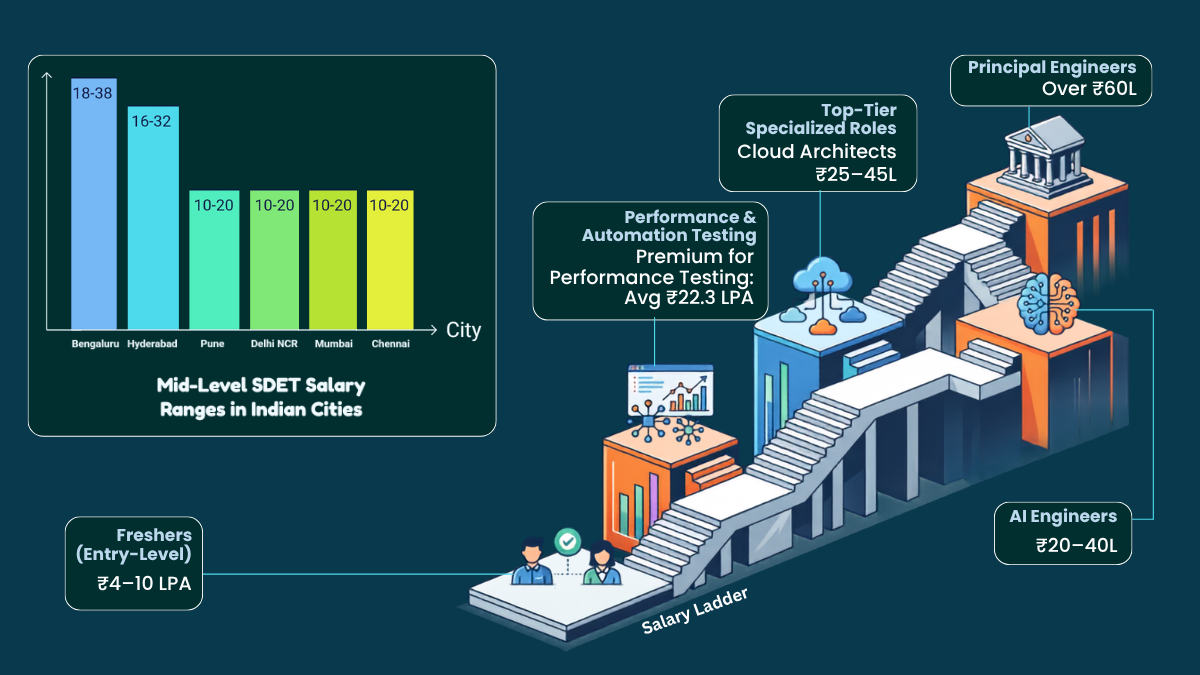
SDET salary progression from ₹4–10 LPA for freshers to over ₹60 LPA for principal engineers, with higher pay in specialized automation, cloud, and AI roles.
The Biggest Pay Jump
The single biggest pay increase available to a tester in India doesn’t come from a yearly review or a promotion cycle. It comes from moving from manual test execution to building automated test frameworks. Understanding why this shift matters so much financially is the most important part of this guide.
Manual testing is still necessary, but the repetitive parts of it are being automated fast. According to NASSCOM’s 2025 industry research, a large majority of Indian testing teams are already using AI-powered tools to handle repetitive checks. Separate research from Gartner suggests AI-assisted testing can meaningfully lower testing costs compared to fully manual approaches.
What this means is that testers who only do manual work are seeing slower pay growth and less job security, while testers who can build and maintain automated test frameworks are seeing their software tester average salary rise faster, because they bring skills the company genuinely can’t replace with a tool.
Moving from manual to automation is really a move into coding. A tester who can write a test script in Python or JavaScript, set up a project properly, write clean and reusable test cases, and plug the whole thing into a CI/CD pipeline is doing engineering work, not just checking boxes. That’s exactly why software tester average salary for SDET-track professionals tends to run well above equivalent-experience manual testers at the same company.
This is one of the clearest, most direct pay upgrades available in Indian IT and the tools used to make this jump have changed quite a bit in just the last two years.
Why Playwright Has Replaced Selenium as the Go-To Framework
3 years ago, almost every testing job post in India mentioned Selenium first. In 2026, that has shifted to Playwright, Microsoft’s newer, open-source testing framework.
Playwright can run tests across Chrome, Firefox, and Safari’s engine from one single test suite, without needing separate drivers for each browser. Its built-in auto-waiting feature solves the flaky test problem (tests that randomly pass or fail) which made Selenium test suites expensive and frustrating to maintain at scale. Playwright also connects easily with CI/CD tools like GitHub Actions, Jenkins, and Azure DevOps, so tests run automatically every time new code is pushed, instead of needing someone to trigger them manually.
For testers building automation skills in 2026, learning Playwright alongside Python or TypeScript is the most direct route into the pay brackets where automation engineers sit. USS’s Software Testing with Playwright Course is built around exactly this covering the following, through real, hands-on project work:
- Playwright setup
- the Page Object Model for building maintainable tests
- API testing with Postman
- Performance testing with JMeter
- CI/CD integration
Graduates who finish this course with a documented Playwright suite on GitHub walk into interviews with the kind of proof senior engineers and hiring managers actually look for.
Full-Stack QA and AI Testing
For testers who want to move past mid-level pay and into the brackets where testing competes with the best-paid roles in Indian IT, two skill combinations stand out in 2026.
Full-Stack QA: a tester who understands both the automated frontend test layer and the backend systems (APIs, databases, services) that the application actually runs on. Full-Stack QA engineers earn ₹10–18 LPA at mid-level, and ₹22–45 LPA or more at senior level. Building this skill means adding backend knowledge on top of a testing foundation. USS’s Java Full Stack Course is built to teach exactly this backend and API layer, making it a natural next step for testers who want to grow beyond frontend automation.
AI/ML Testing Lead: a newer role for professionals who can test AI systems directly. The role involves checking model outputs, testing for bias, checking performance across different types of data, and confirming that a live AI system is actually behaving the way it’s supposed to. This is currently the highest-paying track in testing at senior level, though because the role is new and roles at this level are rare, published figures vary widely and should be treated as directional rather than exact.
USS’s AI Fundamentals Course teaches the machine learning basics that make this specialisation genuinely learnable rather than just a buzzword on a resume. As more testing teams adopt AI tools over the next few years, these roles are expected to move from rare to standard. This means the people building this skill now are likely to become the senior practitioners once that happens.
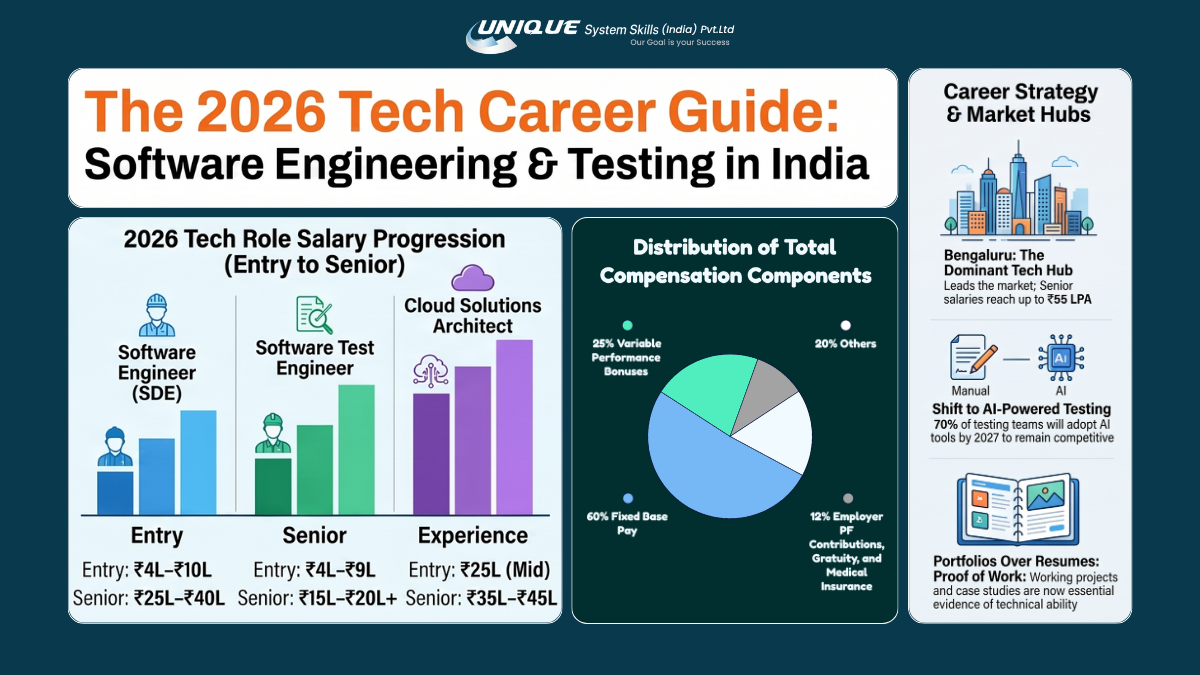
Overview of 2026 software engineering and testing careers in India, including salary progression, compensation structure, AI testing trends, and major career hubs.
How to Aim for the Best Software Tester Pay
Everything in this guide comes down to what you can prove. For the recruiters, you have to build matters more than what certificate you’re holding. Your software tester salary in India depends less on the paper on your wall and more on what you can show an interviewer you’ve actually made, tested, and shipped.
A strong portfolio should answer 3 questions that senior interviewers actually care about:
- What did you build or test?
- What real technical problem did you solve while building or setting up the test suite?
- What was the measurable result — faster test runs, better bug detection, higher test coverage?
A GitHub page with clearly documented test suites, a proper README, and real, specific results is worth more in most technical interviews than a certificate name on a resume.
With the right mix of practical skills, a documented portfolio, and training that matches what Indian employers are actually hiring for in 2026, the ceiling on software tester salary in India is a lot higher than most people in the field currently think.
Going from a ₹3–4 LPA fresher role to ₹25 LPA isn’t about luck or waiting around. It is about building the right skills, in the right order, through real hands-on practice.
Your next step:
- Moving from manual to automation: Software Testing with Playwright Course
- Building Full-Stack QA skills: Java Full Stack Course
- Moving into AI/ML Testing: AI Fundamentals Course
If you are not sure which path fits you, connect with USS for a free counselling session.
Frequently Asked Questions
What is the average software tester salary in India in 2026?
It depends heavily on role and experience.
- Across the field, mid-career QA testers average roughly ₹18.2 LPA,
- with SDET (automation-focused) professionals earning noticeably more, typically ₹12–22 LPA at mid-level and ₹25–40 LPA at senior level.
What is the starting software tester salary for freshers in India?
At IT services companies (TCS, Infosys, Wipro, Cognizant), freshers typically start at ₹2.4–4 LPA. At product companies and GCCs, freshers who already show automation skills can start at ₹6–10 LPA. The national median for fresher testers is around ₹4.25 LPA.
How does software tester salary increase with experience in India?
Pay grows steadily with experience, but the size of the jump depends heavily on skill level: SDET engineers move from ₹4–10 LPA (fresher) to ₹12–22 LPA (mid-level) to ₹25–40 LPA (senior), with the fastest growth going to testers who move into automation and full-stack skills rather than staying in manual testing alone.
Which skills can help software testers earn a higher salary?
Automation scripting in Python or JavaScript, frameworks like Playwright, and API testing with Postman and CI/CD integration all correspond with meaningfully higher pay brackets. These are the skills covered in USS’s Software Testing with Playwright Course. At the higher end, backend development skills (Spring Boot, REST APIs, databases) taught in the Java Full Stack Course, or AI/ML testing knowledge, open up the top-paying tracks in the field.
Do automation testers earn more than manual software testers in India?
Yes, generally by a wide margin. SDET and automation-focused roles tend to pay well above equivalent-experience manual testing roles at the same company, since automation work is treated as engineering rather than manual verification. Testers looking to make this move typically start with a structured programme like the Software Testing with Playwright Course, which builds the automation and CI/CD skills that drive this pay gap.
Which cities in India offer the highest salaries for software testers?
Bengaluru pays the most, with mid-level SDET roles at GCCs ranging ₹18–38 LPA. Hyderabad follows at ₹16–32 LPA. Pune, Delhi NCR, Mumbai, and Chennai are competitive but typically run 10–20% lower than Bengaluru for the same role and experience.
Is software testing a high-paying career in India?
It can be, but the pay ceiling depends entirely on skill direction. Manual testing alone tends to plateau, while automation, Full-Stack QA, and AI/ML testing specialisations open up some of the highest-paying tracks in Indian IT, including senior roles reaching well into 6 figures (USD-equivalent) at global product companies. For testers aiming at the AI/ML Testing Lead track specifically, USS’s AI Fundamentals Course builds the machine learning foundation that specialisation requires.